
Weighted average or FIFO: which inventory costing method fits your business
In short
- The costing method decides what each unit you sell costs and, with it, how much profit the month shows.
- For SMEs in Colombia, IFRS for SMEs (section 13) and IAS 2 allow weighted average and FIFO. LIFO is not allowed.
- When purchase prices rise, FIFO shows a lower cost of sales and an inventory closer to today’s prices; weighted average smooths the changes.
- Switching methods is a change in accounting policy: it is decided with your accountant, from a given date, and documented.
You buy ten hammers at $100, then ten more at $120, and you sell five. What did those five cost you? The answer depends on the costing method, and it is not an accountant’s detail: it changes the month’s profit, the value of your inventory and the number you look at when you set prices.
What a costing method is
It is the rule your system uses to put a cost on each unit that leaves inventory when you bought the same goods at different prices. For SMEs in Colombia there are two allowed rules:
- Weighted average. Every time goods come in, the cost of all units is recalculated as an average. They all cost the same until the next purchase.
- FIFO (first in, first out; PEPS in Spanish). Each purchase becomes a layer with its own cost, and what you sell comes out of the oldest layer first.
IFRS for SMEs (section 13) and IAS 2 allow those two. LIFO, last in, first out, is not allowed; if a software offers it for your books, it is worth asking why.
The same example with both methods
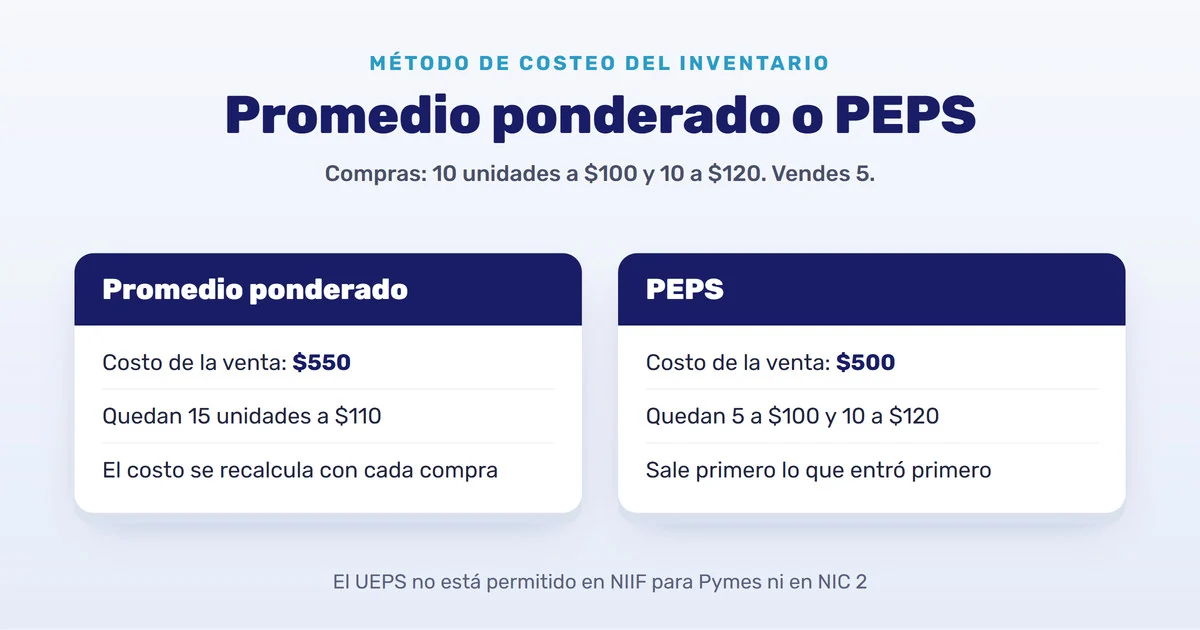
You have 10 units bought at $100 and you buy 10 more at $120. Then you sell 5.
| Weighted average | FIFO | |
|---|---|---|
| Cost of the 5 units sold | 5 × $110 = $550 | 5 × $100 = $500 |
| What stays in inventory | 15 units at $110 = $1,650 | 5 at $100 and 10 at $120 = $1,700 |
| Unit cost you see in inventory | $110 | $113.33 (average of what is left) |
With the same purchases and the same sale, gross profit under FIFO is $50 higher, because the cost of the oldest, cheapest goods goes out first. Those $50 do not disappear: they stay in inventory and show up as cost when you sell the $120 units. The method does not change how much you spent, it changes the month in which you recognize it.
Which one fits what you sell
- Weighted average fits when you handle many items and buy often, like a hardware store or a distributor, and purchase prices do not jump around. It is simpler to review and it smooths price increases.
- FIFO fits when goods move in batches or expire (food, pharmacy, cosmetics), or when purchase prices keep rising and you want inventory valued close to what it would cost to replace it.
Watch out for a common mix-up: FIFO is a costing rule, not a warehouse rule. Costing with FIFO does not ship the oldest batches for you; that is still warehouse discipline.
If you have no clear reason for FIFO, weighted average is a reasonable starting point for most retailers. The final call belongs to your accountant, because it affects the financial statements.
Switching methods is not just another click
Moving from one method to the other is a change in accounting policy. It is done for a reason, from a given date, and your accountant documents it. Switching whenever it suits the month’s profit is not an option.
In practice, the switch starts from the inventory you have today: each product’s stock, at its current cost, is the starting point of the new method.
How the IAnalitics SaaS Platform does it
- The method is chosen in Settings → General → Costing method, and only users allowed to modify Settings can change it. Everyone else sees the method in use.
- With weighted average, the cost is recalculated with every incoming purchase.
- With FIFO, each incoming purchase becomes a layer with its cost. Layers move with sales and their cancellations, point-of-sale returns, invoices, inventory receipts, issues and transfers between warehouses, and product uploads.
- When you switch to FIFO, today’s stock of each product and warehouse becomes its first layer, at its current cost. When you go back to weighted average, the cost continues from where it is today.
What the system does not do on its own, and we would rather tell you before you buy: the journal entry for the cost of sales. The cost of each sale is calculated and shown in Inventory and in sales, but the entry is recorded by hand in the general journal.
The step by step is in the Accounting manual (in Spanish). If you want to see it with your own products, book a demo and we will walk you through it.
Found this useful? Every week we share guides like this one on LinkedIn. Follow IANALITICS on LinkedIn →