
Why many AI chatbots cost five times more than they should
Key takeaways
- About 98% of what you pay for in each AI agent reply is re-reading the same business instructions, not the customer's question.
- Prompt caching stores that fixed part and re-reads it at a fraction of the price, without changing the answer.
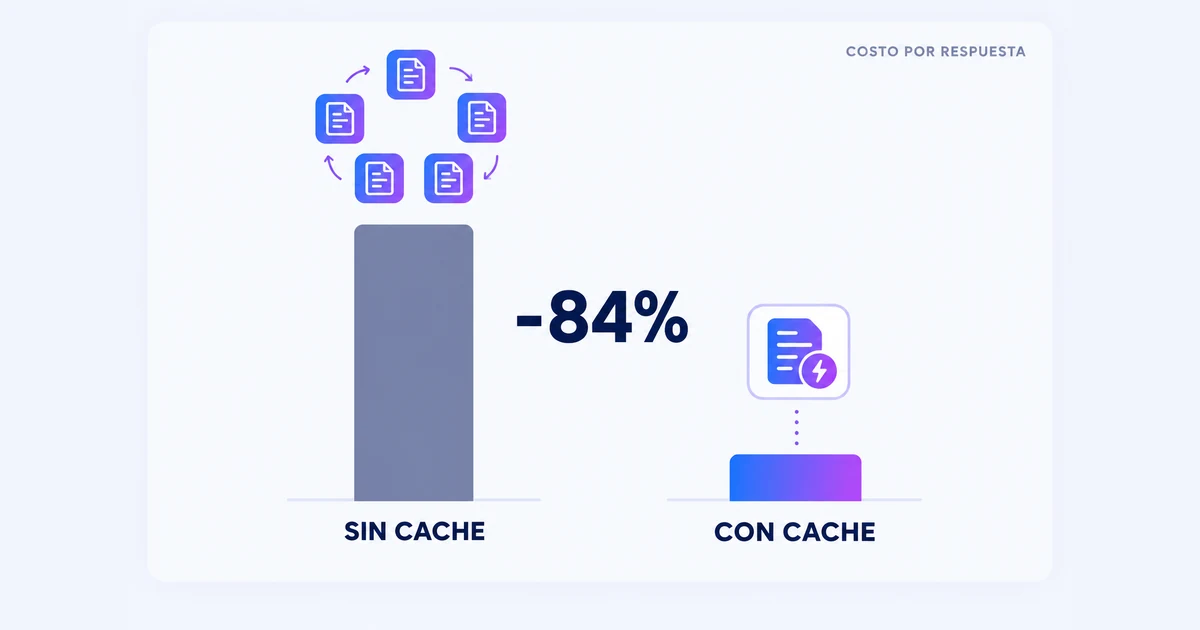
- In our production agent, the measured saving was 84% per reply.
- Before hiring, ask whether they use prompt caching and what share of tokens is reused: something that changes in the script, like the date, breaks it without anyone noticing.
If you are comparing quotes for AI chatbots, you are probably looking at the monthly fee. That is the sensible thing to do. But there is a technical detail almost nobody mentions in a sales meeting, and depending on how it is handled, the exact same service costs five times more or five times less.
It has nothing to do with how much the agent talks. It has to do with how much it re-reads every time it answers.
The problem: 98% of what you pay is re-reading the same thing
An AI agent remembers nothing on its own between one message and the next. Every time someone writes, the system hands the model the full package again: the behaviour rules, the business script, what it sells, at what prices, what it may and may not say, how to qualify a lead.
In a well-built agent that package is around 6,000 units of text — they are called tokens, and they are the unit AI is billed in. What the person on the other end contributes, their question, is about 100.
Do the math: roughly 98% of what you pay on each reply is re-reading text that has not changed.
It is as if, with every message, you handed a brand-new advisor the company's entire folder to read cover to cover, and only at the end told them the customer's question. They charge you for reading the folder every single time.
And a full conversation — greeting, four qualifying questions, objections and a proposed meeting — is around fifteen replies. Fifteen readings of the same folder.
The fix: prompt caching
It has been around for a while and it is called prompt caching. The idea is simple: you tell the model that this block of text is always the same and ask it to keep it in memory.
The first call costs slightly more, because on top of reading it also has to store. Every call after that re-reads the block at a tenth of the price.
The answer the customer receives is exactly the same. Not one word changes. The only thing that changes is the bill.
The number: 84% less per reply
We did not work this out in a spreadsheet. We measured it call by call against our agent in production, the one serving a real client today.
The measured saving was 84% per reply.
Put another way: the same agent, giving the same answers, at the same quality, for a fraction of the cost. That saving is the reason we can offer plans from $99,000 COP a month in a market where the usual starting point is closer to $390,000.
The fine print almost nobody mentions
Here comes the uncomfortable part, and it is the one most worth knowing if you are about to hire someone.
The stored block expires after a few minutes without use. Once that time passes it is discarded and the next reply pays full price again. In a business with conversations spread out through the day, that is normal and there is not much to be done about it.
But there is something worse. If you put anything inside the script that changes every time — the date, the time, a greeting with the person's name, a random number — the block stops being identical and the cache stops applying altogether.
And nobody warns you. There is no error, no alert, the agent answers just as well. You simply pay five times more, month after month, without ever noticing.
That is why our implementation measures, on every reply, how many units of text were reused from the cache. If that number drops, we know something broke in the script before it shows up on the bill.
What to ask your current provider
If you already have an AI chatbot running, or you are about to sign with someone, it comes down to two questions:
- Do you use prompt caching?
- What percentage of my tokens is being reused?
If the answer to the first is yes but they cannot answer the second, the cache may be broken without anyone having noticed. And if they do not know what you are talking about, you are very likely paying more than you should.
We do not raise this to make anyone uncomfortable. We raise it because it is the kind of detail that separates someone who built a real agent from someone who wired two tools together and put a price on it.
How we do it at IANALITICS
Our WhatsApp AI Agent has used prompt caching from day one, with the script deliberately structured so the fixed part stays fixed. We also filter spam and off-topic messages in code — spending no AI at all — and the system has daily and monthly spending caps so nobody can drive up consumption by writing non-stop.
You can see what each plan includes and simulate your cost on the pricing page, or message us on WhatsApp and talk to our own agent: it is the best demonstration we can give you.
Found this useful? Every week we share guides like this one on LinkedIn. Follow IANALITICS on LinkedIn →